
What is Seed Funding: a Guide You Need to Know
13.05.2024
Share
What is Seed Funding: a Guide You Need to Know
Understanding Seed Funding
Understanding seed funding is essential for any startup as it transforms a proposed business model into a fully operational enterprise. The founding team needs a specific amount of capital to validate their concept and develop a Minimum Viable Product (MVP). This funding is typically allocated towards marketing, promotion, hiring skilled team members, and testing core concepts, covering the initial costs of launching the business.
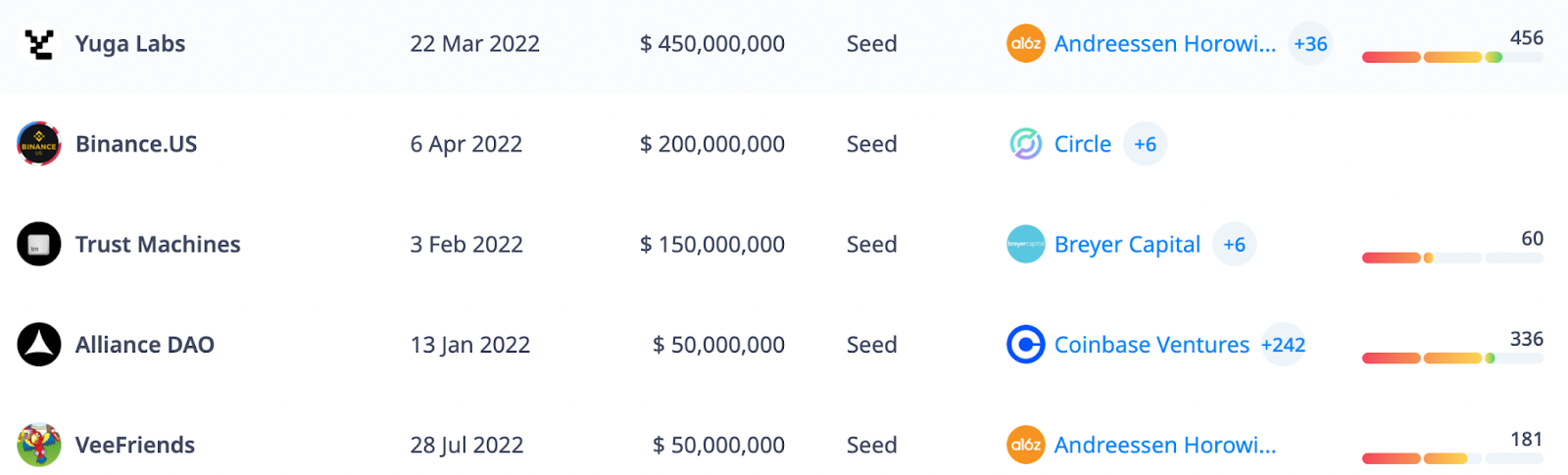
Typically, the amount raised during a seed funding round ranges from $50K to $10-15 million. However, this amount can be significantly higher. According to CryptoRank, the largest seed funding round recorded was $450 million, achieved by Yuga Labs in what became the most successful round to date.
Here’s how the top 5 currently stands:
So let’s find out what seed funding is and why it is crucial for any startup on the market.
What is Seed Funding?
Seed funding is the starting point for any startup, marking the first official funding round that follows pre-seed investments. This initial investment helps a company grow. As previously mentioned, seed funding often comes from those closest to you: friends, family, and early-stage angel investors. It is crucial because it acts as a booster for any promising project, aiding in its growth and scaling.
Investors typically receive an equity stake in the company in exchange for the funds they provide. The seed funding process may also offer other types of returns, such as a stake percentage or a share of later-stage profits. Seed rounds generally take less time than Series A and subsequent rounds, allowing startups to quickly access funds and spend them on crucial activities like product development, extensive market research, A/B testing, software development, hiring a skilled team, and developing a comprehensive MVP.
As mentioned, the amount raised can vary from $50K to $10-15 million, depending on the startup's nature, the Web3 sector it represents, and other relevant business factors. Venture capital firms tend to make larger investments if they believe in the project's potential and wish to expand their equity stake in the company.
Since the average startup usually lacks sales data or history, early-stage investors often consider the estimated growth trajectory, existing track record, management team, market share, and associated risks.
Purposes of Seed Funding for Startups
The purpose of seed funding is to provide a project with sufficient capital to transform a specific idea into reality and to validate if the concept works. The intent behind seed funding aligns closely with the main criteria investors seek in a project. If your project showcases unique benefits and strong points, investors will expect that you use the seed funding to enhance these aspects further. However, there is no guaranteed recipe that ensures 100% investment success.
It's clear that early-stage investors are on the lookout for product-market fit. Thus, if your project meets market demand, it will likely attract investors.
Seed funding rounds vary in size and purpose and depend on the company's and investors' needs. Moreover, investors need to be assured that there is a sufficiently large market for your product or service. Therefore, the essential formula for success is Market Fit + Market Potential = Success.
One of the most critical factors is the team behind the startup. Investors need to be confident that your team possesses the necessary skills to execute your business plan. This involves evaluating the team's experience, track record, and ability to communicate their vision.
Lastly, investors must feel assured about your burn rate, runway, and valuation. Thus, ensure your finances are in order before presenting your project to potential investors.
In summary, if you have a viable idea, a highly-skilled team, an excellent product, a compelling story, and a clear roadmap outlining how the funds raised will be utilized to enhance your project, you stand a great chance of successfully closing the round. One of the most notable examples of a successful seed round this year is Hashkey Group. They raised a massive $100 million. The Hashkey team developed a trading platform with over 155,000 users and had a $630 million trading volume at the beginning of this year. It is Asia's premier digital asset financial services group, so investors felt entirely confident in the project!
Seed Investors for Startups
Various types of investors participate in seed funding rounds. The most common are private investors, as the sums involved are often not large enough to attract major venture capital firms. However, accredited investors, crowdfunding participants, and angel investors also engage in these rounds, depending on the fund's focus and financial capacity.
Angel investors support seed funding by not only providing capital but also offering advice and guidance to help businesses grow and develop their MVPs.
It is crucial to determine the type of seed funding that best suits your business model. This requires a thorough examination of different databases and networks to find the perfect match. Before doing so, you must have a clear understanding of how your company will develop and what is required to reach the next funding level. It is essential to account for the costs of new customer acquisition, marketing, PR, salaries, and more.
Types of Financing Structures
- Crowdfunding: When you create a crowdfunding campaign, you may already be ready for product pre-sales and persuading people to invest in your company before the listing starts. A major drawback of platforms like Kickstarter is that once you've met your project's fundraising goal, you can’t collect any more money. Additionally, most platforms charge fees based on a percentage of the total amount raised.
- Angel Investors: These are individuals who prefer to invest independently. They invest their own capital in early-stage projects they believe in. However, it's important to be aware that angel investors usually expect a larger equity share in return for their investment. Some angel investors may use convertible debt, allowing the money to be converted into shares later.
- Angel Groups: Sometimes, angel seed investors form groups. This type of financing structure is generally more affordable than funding from individual angel investors, as the groups usually don’t demand equity.
- Seed Investment Companies: Venture capitalist firms are specifically created to invest in various startups. Opting for VCs means you are playing the long game and seeking a lasting investment partner who will support you through Series A, B, and C funding rounds. VCs invest in company stakes or equity and expect to yield a capital gain, though not immediately, as they have substantial funding behind them.
- VC Investors: These investors are usually very reliable, as they have been in the sphere for a long time. Moreover, their contributions to startups often include both expertise and funding.
- Accelerators & Incubators: These organizations help startups establish and grow. Similar to angel groups, accelerators and incubators typically do not demand equity in exchange for their expertise. This makes them a perfect match for small startups with limited budgets.
How to Find and Get a Seed Investors Attention?
First of all, it is crucial to understand that researching, finding, and contacting investors may take some time. So it’s better to leave some time space for this process in your roadmap.
- First, you need to start building and developing your investors’ list. You can use Excel, Notion or any other tool for that purpose.
It is important to divide all investors into 3 Tiers - Tier 1, Tier 2, and Tier 3. Tier 1 are the most respected ‘big fishes’. Sometimes it is not necessary to include Tier 1 investors on your list, as the amount of money you need and your project’s scale doesn’t always correspond to these funds’ scale. Then it would be useful to group your investors in sets of ~5-6 so you have the opportunity to better craft your pitch as you move through your sets. The perfect set must include both Tier 1, 2, and 3 investors not to miss anyone - After you’ve settled the initial list, it’s high time to use your network to expand it. Ask your friends, family, and colleagues if they know some investors that may be interested in the project.
- Use online resources. It is crucial to get involved with angel groups and angel investment networks. However, you should be prepared that this is a very competitive environment (and not always healthy). This is the desired place to be for any startup founder, so there will be lots of people like you. That’s why you shouldn’t focus solely on one resource. Check all the main platforms you can use: AngelList, Angel Capital Association, Angel Forum, Life Science Angels, Angel Investment Network, Gust, Tech Coast Angels, Investor Hunt.
- Take part in startup events and compete in them. This is a great litmus test for any founder. If you survive the audience, then you are ready for the battle. Search for the top events for startups (e.g. Web3 summit) and make sure you prepare a clear and brief pitch. Usually startups get lost in the crowd on such events. So you have to make sure you created a list of people you want to communicate with. Prepare your speech, modernize it for each investor, and make sure you don’t shake while pitching.:)
What Documents Do You Need?
Some common legal documents you need to prepare for a seed funding round include the articles of incorporation, bylaws, stock purchase agreement, term sheet, investor rights agreement, and nondisclosure agreement.
That covers the legislative part. When it comes to the pitch itself to secure financing from potential investors, you'll need:
- Business Plan: This document should describe your concept, target market, competitive analysis, marketing strategy, and more.
- Pitch Deck: A visual presentation that outlines all aspects and benefits of your project.
- Financial Projections: These are crucial for investors as they want to see your revenue, expenses, and cash flow forecasts to ensure their investment will be secure.
- Legal Documents: These are the ones we described above.
- Due Diligence Documents: These are necessary for investors to verify the claims made in your business plan.
When's the Right Time to Raise Seed Startups
When determining the optimal time for seed funding rounds, you should consider several criteria:
- Whether you are willing to give up a stake in the company.
- Whether you meet the investor's criteria.
- Whether the market potential is satisfactory.
- Whether the traction and potential are sufficient.
A founder should be fully prepared for the pitch; the team, idea, and roadmap must be polished before presenting to investors. Additionally, it is crucial to develop a comprehensive business plan that outlines how the funds raised during the seed round will be utilized.
However, if you are already a well-known investor, having a compelling story and a solid reputation may suffice. Nevertheless, it is always better to be thoroughly prepared to ensure a smoother process.
How Much to Raise?
The total amount of seed funding depends on the nature of your startup and the specific Web3 sector it originates from. Moreover, you should consider the expectations of investors. Typically, seed capital should be sufficient to meet the requirements of a more complex Series A round. This amount is usually raised within 12 to 18 months.
Thus, you’ll need a clear understanding of what seed funding is and how much money your startup will need to begin development. This means you’ll definitely need a detailed business plan and financial projections.
Once you’ve made all the calculations, it’s time to determine the amount of funding you'll need. On average, funding amounts range between $50,000 and $2 million. If you examine the statistics from CryptoRanks, you’ll understand that there is no one-size-fits-all number; it is always calculated individually with all factors considered. For instance, some startups like Yuga Labs might need $450 million, while other promising startups like Sherlock might only need $1.5 million.
In any case, if you're unsure about how much seed funding you will need, it's wise to consult an experienced startup lawyer. They will be able to analyze the specific financial needs of your business and advise you on the necessary amount of funding.
What Equity to Give?
Any founder is highly motivated to increase their company's valuation. One effective strategy is to offer equity during a seed funding round. This involves selling a percentage of your startup to investors in exchange for financial support.
Before deciding on the amount of equity to offer, it's crucial to consider the type of investor you're dealing with. Venture capitalists (VCs) often want a place on the board of directors, which means they could significantly influence your development direction. Angel investors, on the other hand, typically demand less influence but still want some input in decision-making.
The exact amount of equity you should offer depends on several factors:
- The amount of money you want to raise: The larger the sum, the greater the percentage of equity you'll need to give up. This is because investors seeking to put a significant amount of money into your venture will expect a higher return on their investment.
- The valuation of your company: If your company is valued highly, investors will be more interested in paying more for a stake in a high-value company, potentially allowing you to give up a smaller percentage of equity.
How Long Does Seed Funding Take to Raise?
The seed funding process can be exhaustive, making it essential to develop a clear structure for the raising process and divide it into several steps:
- 1-3 months: Build investor lists and prepare all necessary documents, including legal ones and business plans.
- 3-4 months: Meet potential investors, participate in fundraising events, pitch, tailor your pitch for different investors, and promote on all levels.
- 1-2 months: Finalize the investors’ list and conduct due diligence.
On average, founders raise money between three and nine months. However, it can sometimes take longer, especially when you have a specific innovative product that requires thorough explanation.
According to Docsend, 37% of successful founders close a seed round in 1-6 weeks, 32% take between 7-18 weeks, and the remainder take 19 weeks or more. The timeline depends on several factors: the stage of the startup (early-stage projects usually close the round more quickly), the amount of funding being raised (the more you need, the longer it may take), and the experience of the founders (those with established connections and credibility in the Web3 world can raise funds much faster).
How do Seed Investors Get Paid Back?
After a funding round is closed, investors typically need to wait between 5 to 7 years to see a return on their investment. This duration largely depends on the scale of the project and its roadmap specifics. Often, this process culminates in an Initial Public Offering (IPO), where a company offers shares to the public for the first time. This enables the company to raise additional funds, and investors can recoup their investment by selling their shares.
To understand what seed financing is, one needs to learn all the methods of paying back investors.
The IPO process can be lengthy, making it crucial to consult with a financial advisor or other industry professional before selling shares. It's important to accurately set the share price by assessing the company's value and prospects. Once prepared, you can begin selling your shares to investors. This entire process usually takes 2-3 months and depends on the level of interest and the complexity of the purchase scheme.
If an investor holds a seat on the board of directors, they may claim a percentage of your future returns. This arrangement is negotiable and should be detailed in your business plan. Ensure all your investors thoroughly review this plan and that all legal documents are prepared to secure the process completely.
Investors have the option to sell their shares on the stock market or sell them back to the company. Startups often buy back shares from investors later on.
Despite the lengthy and exhaustive nature of an IPO, it remains the most straightforward method for investors to recoup their investments. However, some investors might prefer receiving a portion of the company's income or dividends, especially if they view the company as profitable and successful in the long term. This is a positive indication that an investor believes in the company’s enduring success.
Additionally, a company might be acquired by another company. In such cases, the acquiring company typically pays a cash or stock purchase price to the founders and early investors, also potentially offering a return on their investment. Early-stage investors may even receive a percentage of the acquiring company's profits.
Typically, startups use a convertible note to structure seed financing. Initially, this is structured as debt (principal plus interest), which can be converted to equity during an IPO under certain circumstances.
Overall, there are numerous ways to generate income depending on the monetization structure of a startup and its business plan.
Conclusion
Seed funding is a significant financial boost for any startup aiming to turn ideas into reality. Firstly, to make the most of a seed funding round, you need to prepare thoroughly. Develop a plan that outlines how you intend to spend the raised funds.
Secondly, always invest in growth initiatives that will help your business scale. Develop an impressive MVP, hire marketing professionals and top-notch developers, and expand into new markets: do everything you can to develop your project and spread the word about it.
Finally, it's important to keep track of your progress. After the round is closed, distribute the funds according to your business plan and start monitoring the effectiveness of their utilization regularly. For instance, track your marketing budget and set specific KPIs (engagement rate, number of followers, media mentions, etc.). Update a form daily to keep up with your progress and make necessary adjustments.
Seed funding can serve as a powerful springboard for your project as it helps to raise the necessary funds quickly and, moreover, to secure financial backers for future rounds. Use this tool wisely, and it will help your project flourish soon.
- Understanding Seed Funding
- What is Seed Funding?
- Purposes of Seed Funding for Startups
- Seed Investors for Startups
- Types of Financing Structures
- How to Find and Get a Seed Investors Attention?
- What Documents Do You Need?
- When's the Right Time to Raise Seed Startups
- How Much to Raise?
- What Equity to Give?
- How Long Does Seed Funding Take to Raise?
- How do Seed Investors Get Paid Back?
- Conclusion